Learn marketing from people who do it
Eighteen hand-picked interviews and talks with people who do marketing for a living, chosen for how they think rather than for tips.
18 videos 17 channels about 15.5 hours checked 18 October 2026
Ask for the best marketing channels on YouTube and you get tip lists, course funnels and growth hacks. No single channel is consistently good. The good material exists, but it is scattered one episode at a time: a positioning consultant on a general-interest podcast, a researcher on an SEO tool's show, a copywriter at a conference.
So this page picks single videos, not channels. Most are conversations with people who do the work, because a good interviewer pushes them past their prepared material. Each card lists the ideas the video actually teaches, with a timestamp that opens the video at that moment and a line quoted from it. Every line was checked against the video's transcript before it was written.
Each card also says where the video falls short. Some speakers have a course to sell, some examples are dated, and some episodes take twenty minutes to get going. Six areas, three videos each, and an exercise at the end of each area, because watching on its own teaches less than it feels like it does.
Positioning and strategy
What you are, who it is for and what you are up against. These decisions come before any ad, post or launch, and every later decision depends on them.
-
 1 h 12 min
The Marketing Expert: Sell Anything with this Trick | April Dunford
April Dunford, Positioning consultant, author of Obviously Awesome; former VP of marketing at tech companies for 25-30 years (as she says in the episode)
The Knowledge Project Podcast interview 2024 starts at 01:00
The clearest long-form version of Dunford's thinking, drawn out by Shane Parrish's questions rather than her own slides. She explains positioning through her own career failures and wins, not a framework recital, and covers B2B buying psychology more than her other appearances do.
How they think
-
Positioning is context, not copy 03:02
The same product means something different depending on the category you put it in: the category sets the competitors, the price and what buyers assume it does.
It is double chocolate caramel cake, but if I put it in the muffin format and I call it a muffin, everything about that is different.
-
Win a small segment the leader ignores, then expand 13:16
A startup can't beat the market leader head-on, so it picks a subsegment where its one uncopyable feature matters most, dominates it, and widens from there.
we narrowed down the positioning instead of saying we were enterprise CRM, we were CRM for investment banks
-
In B2B the emotion is fear, and the real rival is no decision 20:56
Business buyers are afraid of picking wrong in front of their boss, which favours the safe incumbent and makes many deals end with nobody choosing anything.
In B2B, the granddaddy of emotions is fear.
- Watch it if
- Founders and marketers at B2B or tech companies who are not sure what category their product belongs in.
- Where it falls short
- B2B software is nearly the whole frame; she says herself that consumer and luxury brands are outside her wheelhouse. The middle repeats the subsegment idea a few times.
-
-
 1 h 11 min
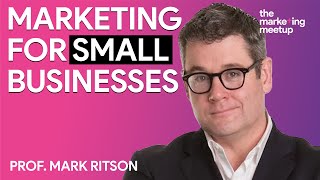
Mark Ritson: Marketing for small businesses
Mark Ritson, Professor of marketing at the Mini MBA (introduced as such by the host); former brand consultant for LVMH brands
The Marketing Meetup talk 2023 starts at 05:38
A 30-minute talk followed by 30 minutes of audience questions, where Ritson adapts textbook strategy (segment, target, position) for companies without big research budgets. Most of his widely shared clips are rants; this one shows the reasoning behind the choices.
How they think
-
Target first, research second 17:55
Without money for big surveys, build a rough map of the market, pick where to play, then go and spend time with eight or ten of those customers to work out positioning.
rather than doing research early on to build the map of the market we're actually going to do what I would say is targeted ethnography
-
Position against the big guy 20:30
A small brand can define itself against a famous rival, borrowing its fame and finding the gap in how it plays; the big brand has no reason to answer.
you can also position against an alternative more Famous Brand in the market
-
Strategy is what you don't do 26:42
Strategy means choosing who you won't serve, what you won't stand for and what you won't chase; that matters more for a small company than a big one.
remember strategy is best described as what we do not do
- Watch it if
- People marketing a small company or early product who were told the textbook process needs research money they don't have.
- Where it falls short
- The first five minutes are housekeeping and sponsor thanks, and it ends with a plug for his own paid course. Crude jokes throughout, and the auto-captions garble some words.
-
-
 1 h 7 min
The Data Behind Great Advertising | Les Binet Interview
Les Binet, Co-author of The Long and the Short of It (with Peter Field); 37 years at the ad agency Adam and Eve (as stated in the interview)
CLIMB interview 2025 starts at 18:01
The strategy question here is how to split money and effort between building the brand and chasing sales now. Binet explains his long-and-short research in plain language with a pizza example, then goes beyond it into ad wear-out and fame. He came from physics and is open about what the data does and does not show; most of his other videos are short conference slots.
How they think
-
Brand building and activation work on different clocks 22:38
Activation (search ads, offers) catches people buying now and pays back fast; brand work plants memories with the many people who will buy later. You need both.
most important word in the long and the short of it is and
-
Brand ads make people feel, not know 31:22
Short-term ads inform and push a sale; long-term brand ads work through emotion, music and craft, and can't be reduced to a message.
It's not really about telling people things. It's about making people feel things.
-
Ads wear out far slower than marketers think 41:39
Teams get bored of a campaign long before most of the public has seen it; most ads are replaced before they stop working.
most ads never get a chance to wear out at all
- Watch it if
- Anyone deciding how to split a budget between performance and brand, or who needs the argument for brand spend explained without jargon.
- Where it falls short
- The first 18 minutes are sponsor reads and his career story. He admits he is out of his depth on creative craft, and the John Lewis case runs long.
-
Then do this, away from the screen Write one sentence that says what your product is, using the category a buyer would file it under, and who it is for. Then list what that buyer does today instead. That list is your real competition, not the companies you would name.
Brand and how people actually buy
What research on real buying says, which often goes against marketing instinct: most buyers barely think about you, and the job is to be easy to recall at the moment they buy.
-
 55 min
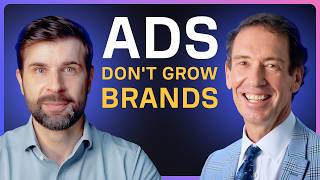
What Marketing Science Says About Growing a Brand | Professor Byron Sharp (Ehrenberg-Bass Institute)
Byron Sharp, Director of the Ehrenberg-Bass Institute, author of How Brands Grow (as introduced)
Ahrefs Podcast interview 2026
The host pushes back (he argues a bigger ad budget simply buys a bigger brand), so Sharp has to defend his ideas instead of reciting them. It also translates the supermarket-shelf research into software and online buying.
How they think
-
Mental availability is about cues, not awareness 17:51
Everyone knows Coca-Cola, yet it rarely comes to mind at the moment someone picks a drink; the job is linking the brand to the situations where people buy.
mental availability is a share thing of like, well, how often do they?
-
Advertising keeps a brand up more than it lifts it 11:48
Ads are a weak force: doubling a budget changes little, but stopping slowly loses ground. Big brands often got big through history and luck, and stay big through marketing.
it's better at keeping the plane up when it's already up than it is of driving the plane up there in the first place
-
Distinctive, not differentiated 37:25
Brand assets like Geico's gecko or Yellow Tail's kangaroo help people recognise and find you; they are not reasons to buy, and competing brands are rarely as different as marketers think.
They're just looking like you so that when when a consumer when there is a touch point, they realize which brand it is.
- Watch it if
- Anyone who believes the funnel, buyer personas or a unique brand purpose drive growth and wants the evidence-based counter-view, especially software marketers.
- Where it falls short
- The host steers back to his own product (Ahrefs measures brand searches) near the end, and Sharp plugs a paid course. Little on how to make the creative work itself.
-
-
 45 min
Rory Sutherland - Alchemy: The Surprising Power of Ideas That Don't Make Sense
Rory Sutherland, Vice Chairman of Ogilvy UK, co-founder of its behavioural science practice (per the video description)
The Welcome Conference talk 2025
Sutherland's argument in 45 minutes, given to hospitality operators, so every idea is tied to a concrete business example (hotel room names, airline booking pages, Buc-ee's toilets) rather than to advertising alone. Tighter than his two-hour podcast appearances.
How they think
-
Change the perception instead of the product 08:11
Many problems treated as engineering problems are really psychology problems, and fixing how something feels is often far cheaper than fixing what it is.
If it's cheaper to reduce anxiety than to increase range, that's what we should do.
-
Value is relative 15:57
People judge a price against what sits next to it, so showing economy and premium side by side sold more premium seats than making people pick a class first.
It's a relative measure not an absolute measure.
-
Reverse benchmarking 33:50
Don't copy what competitors do well; find what the whole category does badly and do that brilliantly, because surprise is what people remember.
Find out what the other people are doing badly and do it really, really well.
- Watch it if
- Product and marketing people who default to rational fixes (faster, cheaper, more features) and want a different lens on why people choose.
- Where it falls short
- A string of anecdotes with no single thesis, and the evidence is mostly stories rather than data. Some jokes aimed at the room. Ends with a plug for his course.
-
-
 39 min
Building Brands That Buyers Remember with Jenni Romaniuk
Jenni Romaniuk, Research professor at the Ehrenberg-Bass Institute for Marketing Science; author of Building Distinctive Brand Assets, Better Brand Health and How Brands Grow Part 2 (as introduced)
The Marketing Architects Podcast interview 2025 starts at 04:08
The practical companion to Sharp: Romaniuk created the category entry point and distinctive asset ideas and explains how to use and measure them, including the mistakes she sees in clients' lists. Short and dense once the hosts' warm-up is over.
How they think
-
Category entry points are about buyers, not brands 21:02
Map the situations and needs people have before any brand comes to mind (packing the kids' lunch, needing coffee after a meeting), then link your brand to the common ones. 'Trust' is not one, because it describes a brand.
So they're not about brands, they're about buyers.
-
A brand asset needs fame and uniqueness 08:18
A logo, colour or character only works if most people link it to you (fame) and to nobody else (uniqueness); a shared one spends your money reminding people of competitors.
Uniqueness is about do we own this asset? Are we the only brand that comes to mind when this asset is present?
-
Light buyers carry the brand 28:43
Most of a brand's buyers buy it rarely and hold only faint memories of it, so they are the first to slip away when marketing stops. Reaching them is growth and insurance at once.
when brands decline, it's light buyers that drop off first
- Watch it if
- Marketers rebranding, building a brand tracker or writing briefs, who want to know which brand memories matter and how to check them.
- Where it falls short
- Four minutes of host banter before the first question, and a plug for the institute's paid course near the end. Her claim that brands don't need to be differentiated is stated, not argued, here.
-
Then do this, away from the screen Pick something you bought recently in a category you hardly think about. Write down the moment you decided and which brands came to mind then. Do the same for your product's buyer.
Audience, content and search
Finding where the people you want already pay attention, and making things worth their time there, now that search and social platforms keep more clicks for themselves.
-
 40 min
Zero-Click Marketing with Rand Fishkin
Rand Fishkin, CEO & Co-founder, SparkToro (co-founder of Moz)
Turing Fest talk 2025 starts at 08:24
The clearest 40 minutes on why clicks and attribution stopped telling marketers the truth, built on SparkToro's own clickstream and referral studies, and what to measure instead. He covers more ground here than in any of his podcast interviews.
How they think
-
Measure lift, not clicks 03:14
Coca-Cola could not track a single billboard viewer, so it compared sales in a city with the billboard against a similar city without it. You can still measure marketing that way.
we think that this billboard probably provided 1.5% lift in the geographic area where people saw it
-
The flyer kid in the alley 26:40
Ad platforms often show ads to people who were already on their way to buy, then take credit for the sale. A channel that looks great in attribution reports may not be creating any new demand.
why would you work hard to make more sales when you can just take credit for the sales that were already going to happen
-
Brand searches come from somewhere else 35:31
When someone hears about you and then Googles your name, Google gets the credit for the click. The demand was created elsewhere, so don't give search the credit for it.
no search for a brand deserves to be attributed to Google that demand was created somewhere else
- Watch it if
- Anyone asked to prove content, social or PR with click attribution, and founders deciding whether to pour money into ads.
- Where it falls short
- The first eight minutes are jokes and setup. There are political asides throughout, the data dates from 2024, and he plugs SparkToro. The bonus tips at the end are rushed.
-
-
 1 h 2 min
I Debated the Inventor of Zero-Click Marketing | Amanda Natividad (SparkToro)
Amanda Natividad, VP of Marketing at SparkToro, co-author of Zero-Click Marketing
Ahrefs Podcast interview 2026
The host argues against her on purpose: if nobody clicks, how does anyone buy, and why not pay to promote content? So she has to defend her ideas, not just recite them. She also describes how she actually develops an idea and spreads it.
How they think
-
Value before the click 02:03
Give people the complete useful thing where they already are, rather than holding back the payoff to lure them to your site. People will look you up when they're ready.
It means creating value before the click and not being dependent on that click to happen every single time.
-
Take your idea on a tour 12:26
Test an idea as a short post, run it as a webinar where people push back, then turn it into a blog post, podcast talking points and finally a talk. Each round sharpens the idea.
the webinar would be it would basically be like my draft blog post
-
Search captures demand, it doesn't create it 46:40
People only search for what they already know about. What gets said about you in public is what makes them want it in the first place.
search only captures demand, but the public record creates it
- Watch it if
- Content and social marketers whose posts get reach but no clicks, and anyone who has to explain to a boss why that is fine.
- Where it falls short
- It's partly a book launch. The last third is a debate about how often to post on LinkedIn, followed by a rapid-fire round, and both matter less. The SparkToro-on-SparkToro section near the end is close to a product demo.
-
-
 31 min
The New SEO Pipeline: How Brands Win in AI Search w/Kevin Indig, Organic Growth Advisor
Kevin Indig, Organic growth advisor; led organic growth at Atlassian, G2 and Shopify
97th Floor interview 2026
Of the AI-search talks we found, this one has the least hype and the most evidence: he cites his own user studies and says plainly where the data stops. It's a short, dense way to see how SEO thinking changes when the answer comes from an AI chatbot rather than a list of links.
How they think
-
Retrieved, cited, trusted 04:09
Being crawled by an AI doesn't get you cited, and being cited doesn't get you picked. In his study, users chose the top item on an AI shortlist unless a brand they already trusted appeared on it.
The only exception to that is when they see a brand on their short list that they trust.
-
Optimize for the bot's searches 07:48
AI tools run their own background searches before answering. The queries that matter may have no human search volume at all.
we have to optimize more for keywords that might not have search volume, at least not from humans, but from bots.
-
Join a conversation people already care about 18:40
Original data gets cited, but only when it answers a question your buyers are already asking. Look at what is happening in your market first, then find data that speaks to it. Don't start from whatever data you happen to have.
it's only going to get attention if you join a conversation that is relevant to the people you're trying to talk to
- Watch it if
- SEOs and content leads working out what to change for ChatGPT, Gemini and AI Overviews.
- Where it falls short
- It is tied to mid-2026 tools and model versions, so the tactical parts will date quickly. It's mostly the host asking about his studies, so there are few stories, and the start is dense with jargon (fan-out, RAG, citations versus mentions).
-
Then do this, away from the screen Name five places (newsletters, podcasts, communities, accounts) where your audience pays attention. Check each one before you write any content.
Copy and messaging
The words: headlines, landing pages, emails. Mostly this is listening to customers and saying something specific enough to picture.
-
 1 h 11 min
Learn Copywriting in 76 Minutes – Harry Dry
Harry Dry, Copywriter, runs Marketing Examples
David Perell interview 2024 starts at 01:32
Harry Dry gives you rules you can check any sentence against, then shows you how he works: about 25 rewrites of one ad in Figma, with every change explained. David Perell keeps pushing for the reasoning behind each choice.
How they think
-
Visualize, falsify, nobody else can say it 00:00
Check every line with three questions: can I picture it, could it be proved true or false, and could only we say it? Three no's mean filler.
Can I visualize it? Can I falsify it? Can nobody else say this?
-
Don't talk, point 08:16
Rather than describing something with adjectives, point at evidence: a chart, a fact, a person. It makes you do the research.
It it it basically it gets you off the adjective trail.
-
From point A to point B 21:39
Before writing, name what the reader thinks now and what you want them to think. Then work out who you're talking to, what you have to say and how to say it well.
what's the current attitude? What's the desired attitude? That's point A, that's point B.
- Watch it if
- Anyone who writes landing pages, ads or headlines and wants a test for whether a line is good, beginners included.
- Where it falls short
- At 71 minutes it's long. Much of the middle is reacting to famous ads, the newsletter section is less about copy, and he mentions his own copywriting course. Perell's interjections and the football stories sometimes slow it down.
-
-
 32 min
Joanna Wiebe: How to use the voice of the customer to write high-converting copy - CXL Live 2019
Joanna Wiebe, Conversion copywriter, Copyhackers
CXL talk 2020
A practical talk on finding copy in what customers say, from founder interviews, sales calls and thank-you-page surveys, showing the exact lines she pulled and the headlines that came out of them. It's the clearest case for treating copywriting as listening.
How they think
-
Copy is 90% listening 03:09
Only a small part of the job is writing. The rest is collecting the words customers actually use, because your own opinion on why someone should buy doesn't count.
is just listening to customers because nobody cares about the English majors opinion on why you should buy that piece of software
-
Breakthrough or bust 09:27
Before testing a line, ask whether it's different enough that it could either win big or fail badly. A safe line won't teach you anything.
ask our copy is this pushing things far enough that could either be a dramatic breakthrough or a total bust
-
Documentary-style moments 22:29
In sales calls, listen for moments so vivid someone could act them out. Nobody in a meeting room would think of them, and they make copy specific.
could they act it out and that's a really good moment that's something that you can't come up with in a boardroom
- Watch it if
- Marketers and founders who have customer interviews, reviews or sales calls and don't know how to turn them into copy.
- Where it falls short
- It's a 2019 conference talk that refers to slides, so some examples are hard to follow by ear. It's strongest on research and weaker on writing craft, and the closing Q&A on SEO is brief.
-
-
 50 min
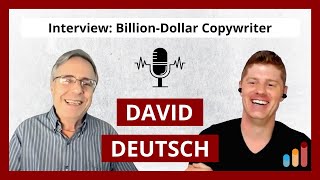
Billion-Dollar Copywriter David L. Deutsch [interview]
David L. Deutsch, Direct-response copywriter; started at Ogilvy & Mather, promotions credited with over $1 billion in sales
Roy Furr interview 2022 starts at 06:14
Classic direct-response thinking from someone who has done it for decades. He gives simple models (the benefit-versus-believability square, the 'so what' chain) that apply to any product, not just direct mail.
How they think
-
Talk onto the page 00:32
Weak writers compose word by word, while good ones write the way they'd persuade someone in person. Everyone can already persuade; the trick is using that skill when you sit down to write.
the best writers it's like they're just talking onto the page
-
The magic copy square 20:48
Plot benefit against believability. Big promise with no proof is hype, proof with no promise is 'who cares', and you need both to sell.
if you have enough benefit and you've got a lot of believability then it's like sold
-
Ask 'so what' until it matters 24:30
Take a benefit and keep asking what it means for the reader's life. 'Less arthritis pain' becomes 'you can pick up your grandkids'.
you'll make more money well so what what does that mean
- Watch it if
- People who already write copy and want the reasoning behind persuasion, beyond tips on wording.
- Where it falls short
- The first five minutes are a long bio. The examples lean heavily on supplements and financial newsletters, and the channel promotes the host's paid training.
-
Then do this, away from the screen Take a headline you wrote and run Harry Dry's three tests on it: can I picture it, could it be shown true or false, could only we say it. Rewrite it until it passes all three, using words a customer actually said.
Growth and distribution
How a product finds its users: channels, loops and the fit between product, price and channel. This is the part of marketing closest to product work.
-
 1 h 10 min
Brian Balfour: Startup Growth Secrets from HubSpot; Distribution Stratagies; Impact of AI | E1049
Brian Balfour, Founder and CEO of Reforge; previously VP of Growth at HubSpot
20VC with Harry Stebbings interview 2023 starts at 0:06:30
The clearest single conversation on growth as a system: he keeps pulling the host's tactical questions back to 'how does your product grow' and works through it with real HubSpot and Loom cases, including a mistake of his own. Low view count, but the content is denser than his better-known talks.
How they think
-
Growth model, not business model 0:08:00
Before picking tactics or metrics, write down how one new user leads to the next one. A financial model is about money in and out; a growth model is about users in and out, and its levers are different.
When I put a user in, how do I get more than one user out?
-
Product-channel fit 0:22:30
Platforms like Google, Facebook and Apple set the rules, so the product has to be shaped to work inside one channel, not the other way round. Building first and bolting on distribution later usually fails.
We cannot mold channels to products. We have to mold the product to the channel
-
Channel-model fit 0:23:30
Each channel only works at certain price points. Virality and paid ads suit cheap, low-friction products; sales suits expensive ones. Price and channel have to match.
So you can't use viral loops for a product that you're charging 10 thousand dollars up front for.
- Watch it if
- Founders and marketers who have tried many channels without a clear reason, and anyone who wants to understand loops, constraints and when to kill a channel.
- Where it falls short
- Very B2B-SaaS centred. From about 0:57:00 it turns into a quick-fire round, including Threads vs Twitter predictions that have aged badly. Audio-podcast format with no slides, so the frameworks are described rather than drawn.
-
-
 1 h
Andrew Chen | The Cold Start Problem: How to Start and Scale Network Effects | Talks at Google
Andrew Chen, General partner at Andreessen Horowitz; author of The Cold Start Problem; previously ran growth teams at Uber
Talks at Google interview 2021 starts at 0:12:30
A moderated conversation after a short slide intro, built on concrete origin stories (Tinder's USC party, LinkedIn's first users, Reddit's fake accounts, Clubhouse invites). It explains why products that connect people start small, which most growth advice skips.
How they think
-
Atomic network 0:13:30
Work out the smallest group that has to be on the product at once for it to be useful (2-3 for Zoom, a team for Slack, hundreds of drivers in a city for Uber), win that group, then copy it.
how many people need to be connected at the same time doing the same thing in order for that product to be valuable
-
Hard side vs easy side 0:18:30
One side of a network (creators, sellers, drivers) does more work and is pickier and more valuable. Build features that make that side happy, as Tinder's swipe did for its most sought-after users.
every network product has what I describe as an easy side and a hard side of the network
-
Invites copy the network 0:38:30
Invite-only launches work less because of hype than because every invited person already has a connection inside, so new users land in a group that already works.
when you are invited into a product, that means you are already connected with one other person
- Watch it if
- Anyone launching a marketplace, community, social or collaboration product, or trying to understand why big companies fail to copy small ones.
- Where it falls short
- Mainly about products with network effects (marketplaces, social, team tools); less useful for a single-player product. Partly a book launch, the first 10 minutes are a book overview, and from about 0:47:30 it detours into Web3/NFTs (very 2021) and then a personal quick-fire round.
-
-
 27 min
Head of Growth at Lovable | Why Growth Playbooks Are Crumbling—and What’s Next
Elena Verna, Head of Growth at Lovable (previously growth at Dropbox, Miro, Amplitude)
Product School talk 2025 starts at 0:00:30
A short, current talk from someone running growth today, on what happens when search and social stop sending traffic. It covers loops, freemium and founder social in 26 minutes, so it complements Balfour's longer system view.
How they think
-
Distribution beats product 0:01:00
A great product with no built-in way to reach people dies slowly, while mediocre products with strong distribution win. Product teams have to own distribution, not hand it to marketing.
what builds a successful company is having a great distribution for your product
-
Loops over funnels 0:03:00
The fastest-growing companies grow through cycles where a user's action brings in the next user (Dropbox shared files drive 60% of its acquisition), not through a one-way funnel you keep refilling.
They don't grow via funnels. They grow via loops.
-
Free product as marketing budget 0:17:30
At Lovable most cost is free usage, and they count it as marketing spend: better to give the product away than to pay ad platforms for attention.
we look at it not as a cost center. We're looking it as our marketing budget
- Watch it if
- Product people and early marketers who want a current view of which channels still work and why the product itself has to carry distribution.
- Where it falls short
- Partly a pitch for Lovable and the AI wave, so some claims (SEO collapse, 'vibe-code your own SaaS') may date quickly. The G2 traffic chart is on a slide you only hear about. The video description promises answer-engine optimisation, which the talk barely covers. A list of options, each touched briefly.
-
Then do this, away from the screen Draw your product's growth loop. A new user arrives, then what brings in the next one? If the drawing stops at the first user, that is the finding.
Product marketing and launches
Getting a product out and into people's hands: launches, founder-led marketing, and spreading through one community before the next.
-
 1 h 31 min
An inside look at Figma’s unique GTM motion | Claire Butler (first GTM hire)
Claire Butler, Figma's first go-to-market hire and 10th employee; led the launch out of stealth; Senior Director of Marketing
Lenny's Podcast interview 2023 starts at 0:13:00
The one Lenny episode in this set, chosen because it is the most concrete account of launching and marketing a product to an audience that hates being marketed to: renaming the product on day one, launching without the key feature, technical content instead of ads, one channel (Twitter). Full of first-hand detail rather than frameworks.
How they think
-
Win the individual, then let them sell it inside 0:14:00
Figma's motion was bottom-up: make the people who use the tool all day love it so much that they spend their own credibility getting their company to adopt it. No sales team for the first three years.
they love you so much that they're willing to put their social capital and themselves in the line and spread the product
-
Don't market to experts; earn credibility 0:34:00
Designers ignored buzzwords, so Figma published deep technical posts by its engineers and designers. Her test for whether a post was good enough: could the marketer have written it?
if I could have written it myself it was probably too basic
-
Go where they already are 0:44:30
Early on nobody will come to your Slack or forum. Find the one place your audience already gathers (for designers, Twitter), map who influences whom, and put your effort there only.
where can you go where they already are as opposed to making them come to you
- Watch it if
- Founders and first marketers at product-led or bottom-up B2B tools, especially ones selling to developers, designers or other skeptical experts.
- Where it falls short
- 91 minutes with sponsor reads, and the first 12 minutes are background. The playbook fits tools with a passionate, technical, single-player audience; she says herself it is easier when the product is technical, so it transfers less well to products people don't care about.
-
-
 21 min
The Best Way To Launch Your Startup | Startup School
Kat Mañalac, Head of YC's Outreach team; advises founders on their launches during the YC batch
Y Combinator talk 2023 starts at 0:00:30
The most practical short talk on launching found: someone who has watched 3,500+ YC companies launch argues for many small launches instead of one big one, and shows how to write the one-line description that every launch depends on.
How they think
-
Launch is a habit, not an event 0:01:00
Founders spend months polishing one launch, then nobody notices. Launch early and repeatedly (Airbnb launched three times) and treat each one as a test.
I want you to think about launching as something that you do continually
-
Say what before why 0:05:00
Open with the company name and what it does, in plain words with no jargon, so the listener could roughly picture what you built. The backstory can come later if they ask.
we recommend leading with what not with why
-
Each channel is a different audience 0:12:00
A landing page, friends and family, strangers, online communities, a waitlist: each launch reaches different people, so launching in many places also tells you who your users really are. Press won't do this for you.
different channels will naturally reach different audiences
- Watch it if
- First-time founders and makers about to put something in public, and anyone stuck polishing a launch that hasn't happened yet.
- Where it falls short
- A talk, not a conversation, and aimed at very early startups (landing page, first users); little for a company launching a second product or a big release. Some sections (TikTok, pre-orders) are skimmed with links to guides.
-
-
 28 min
Fostering founder brand as a competitive advantage with Dave Gerhardt
Dave Gerhardt, Former marketing lead at Drift and CMO at Privy; founder of the DGMG marketing community
Wynter interview 2022 starts at 0:00:00
A tight 28-minute interview on founder-led marketing with two contrasting cases from his own work: Drift (known founder, no distribution) and Privy (half a million users, unknown founder). Shorter and more focused than his other interviews found.
How they think
-
People buy from people 0:04:30
In a crowded market where products look alike, buyers pick the company whose founder they already follow and trust. Early Drift customers came because they liked David Cancel's podcast and point of view.
people want to work with people they feel like they know and they like and they trust
-
Your story is your strategy 0:08:30
Drift positioned itself as chat 'built for sales and marketing' against Intercom's product focus, and the roadmap had to keep proving it. The message only works if the product backs it every week.
this is why people say your story is your strategy
-
Post often to test ideas 0:19:30
Posting most days is not about reach; each post is a test of an idea with your ideal customers, and what lands becomes the newsletter, the talk, the book. You still need two or three strong opinions to say.
the whole magic in social media is the feedback loop
- Watch it if
- B2B founders deciding whether to be the face of their company, and first marketers working with a founder.
- Where it falls short
- Measurement is hand-waved ('you get more inbound, period') with screenshots of nice comments as the evidence. Recorded in 2022 when Twitter/LinkedIn dynamics differed, and he can't name a current example when asked.
-
Then do this, away from the screen Write a launch post that says in its first line what the product does. Show it to three people, ask what they think it does, and compare their answers with what you wrote.
Considered and left out (18)
-
Mark Ritson's 4-Step Marketing Strategy
Strong candidate (a long conversation with Louis Grenier), but YouTube's auto-captions are detected as French, so the content could not be checked against a transcript. Worth a manual look; it could replace the Meetup talk as the Ritson pick.
-
A Buyer-Centric Approach to Competitive Positioning
April Dunford alone on her own podcast. Useful split of competition into status quo, direct rivals and 'do nothing', but it repeats much of the Knowledge Project episode with no one questioning her.
-
Les Binet and Peter Field present their new research 'Effectiveness in Context' at EffWeek #2018
Close call. Its best idea is counterintuitive (when selling is easy, such as online or subscription brands, put more into brand building, not less), but it is a report launch that leans on slides and starts with a sales pitch for the report. The CLIMB interview covers the core more clearly.
-
Marketing Expert: The Playbook Behind Every Great Campaign | Rory Sutherland
Two hours on the same channel as the Dunford pick. Chose his 45-minute talk instead for density and channel variety; not reviewed in full.
-
Interview: Rory Sutherland, author of Alchemy, on why irrational ideas work
Almost 2.5 hours. Too long for a first watch when the Welcome Conference talk carries his main ideas; not reviewed in full.
-
The Marketing Secrets Apple & Tesla Always Use: Rory Sutherland | E165
Diary of a CEO: very popular, but the channel's packaging is hype-led and it runs 98 minutes. Not checked against a transcript.
-
Audience Is Everything: Rand Fishkin on AI Search, SEO, and the Future of Marketing
The first half is excellent: lift-based measurement, and a post-purchase survey test where buyers credited food celebrities who had never mentioned the product. But from about 34:00 it turns to his personal life and cooking, and the marketing ideas overlap with his Turing Fest talk, which we picked.
-
Ross Simmonds: Content chaos - building your brand through constant experiments
Its 'build, ship, learn, decide' loop and the Reddit and Quora stories are fine, but it's from 2017 and the examples (Instagram shoutout groups, Quora answers picked up by Forbes) are out of date. It's mostly anecdotes and has few ideas you can reuse.
-
Attribution Is Dead. Now What? w/ Rand Fishkin, CEO & Co-Founder of SparkToro
Downloaded but not reviewed in depth. It's a third Rand Fishkin video on attribution, and the Turing Fest talk already covers that topic.
-
How to write copy that moves people w/ Eddie Shleyner
Useful basics, such as 'tease the value and embellish the benefit', starting in the middle of the story, and the point that people run from pain faster than they run to pleasure. But the questions keep it at beginner level, and the last third is about mentorship and tools. Deutsch covers direct-response thinking in more depth.
-
How to Be Specific: From-The-Trenches Lessons in High-Converting Copy – Joanna Wiebe
Downloaded but not reviewed in depth. It's the same speaker as the CXL talk we picked, and it has far fewer views (585).
-
Stories, Creativity, and Where to Find Ideas from Eddie Shleyner, VeryGoodCopy
Not reviewed in depth. It's a second Eddie Shleyner video, and from the title it's about finding ideas more than writing words that sell.
-
Elena Verna: How Lovable Launches Product & Hacks Social to Go Viral
Strong and recent (paid growth as a 'death trap' before you know your numbers, payback period over LTV, freemium as marketing, daily releases plus tier-one launches), but it is 71 minutes, the same channel as the Balfour pick, and overlaps heavily with her shorter Product School talk. Best alternate if a longer Verna interview is wanted.
-
Pinterest's Casey Winters gives crash course in growing a startup (or, WTF is growth?)
A 92-minute talk from 2016 (This Week in Startups). Only the opening was reviewed: it starts from the same 'understand why, not copy tactics' premise as Balfour, but the examples are a decade old and it runs long.
-
Kyle Poyar, OpenView - How to Grow Faster with $0 CAC: Your Guide to Virality, Community, and PLG
A 21-minute conference talk; the first part reviewed leans on benchmark survey numbers and case examples (Grammarly, SafetyCulture). Useful, but closer to a research report than a practitioner explaining how they think.
-
How to build a powerful marketing machine | Emily Kramer (Asana, Carta, MKT1)
Excellent practitioner thinking (marketing as 'fuel and engine', the GACCS brief before any launch, impact goals not activity goals), but it is a Lenny episode and only one was allowed; its focus is hiring and organising a marketing team more than launching or messaging. Strong pick for a 'building a marketing team' section.
-
How to Build a "Founder Brand" with Dave Gerhardt of DGMG
Covers the same founder-brand ground as the Wynter interview but runs 48 minutes, the host talks a lot, and a long middle section is about Gerhardt's own community business.
-
Elena Verna: How Lovable Launches Product & Hacks Social to Go Viral
Its launch section (daily releases, tier-one launches every one to two months, employees amplifying posts) starts at 49:30 and is only a few minutes; the rest is growth and would repeat the growth area's Verna pick.
What this page cannot do for you
- Watching feels like learning more than it is. Without the exercise after each area, these are good podcasts, not a course.
- This is a first selection of eighteen videos, not complete coverage. Paid acquisition, pricing, lifecycle email and community are not here yet.
- Speakers disagree, and the page leaves that in. Byron Sharp and Mark Ritson, for example, would argue about targeting. Notice where they disagree; it shows you where the field is unsettled.
- Titles, lengths and channels were read on the date above. A video can be renamed, cut or taken down, and the page will lag behind.
More hand-picked videos: YC Startup School, for people building something small.
Building something? How to build a digital product, on YouTube picks whole channels for the other half of the job.